Why Rouge Valley Sliding Doors Are Costing You Money Every Winter
If you live in a 1980s or 1990s tract home anywhere from Central Point to White City, you already know the problem. Those builder-grade vertical blinds hanging on your sliding glass doors looked fine when the house was new. Thirty years later? They’re letting drafts slice through your living room every time Pacific Power sends a bill that makes you wince.
The Rouge Valley winter doesn’t forgive energy waste. With average January lows dropping to 30°F and heating costs climbing 14% since 2020 (Source: U.S. Energy Information Administration, 2023), your sliding door window treatment isn’t just a style choice—it’s a line item on your monthly budget. Traditional vertical blinds offer an R-value of roughly 0.5 to 1.0, meaning they provide almost no meaningful insulation between your home and the outdoors (Source: Lawrence Berkeley National Laboratory, Window Technologies Report, 2022).
Panel track blinds solve both problems at once. You get a modern, clean aesthetic that updates your home’s look, plus measurably better draft protection that your Pacific Power statement will reflect within the first billing cycle.
The Real Cost of Keeping Outdated Vertical Blinds
Homes with single-pane sliding doors—common in Rouge Valley construction from that era—lose up to 30% of their heating energy through windows and glass doors (Source: U.S. Department of Energy, Energy Saver Guide, 2023). Your vertical blinds aren’t helping. The gaps between each vane, the worn bottom weights that no longer hang straight, and the brittle plastic clips that break when you breathe on them all contribute to continuous air exchange.
One Central Point homeowner we worked with, Mark T., measured the temperature differential along his sliding door before and after switching to panel tracks. He recorded a 7°F improvement in floor-level temperature during a 28°F January evening—and his Pacific Power bill dropped $34 the following month.
What Makes Panel Track Systems the Best Vertical Blinds Alternative for Rouge Valley
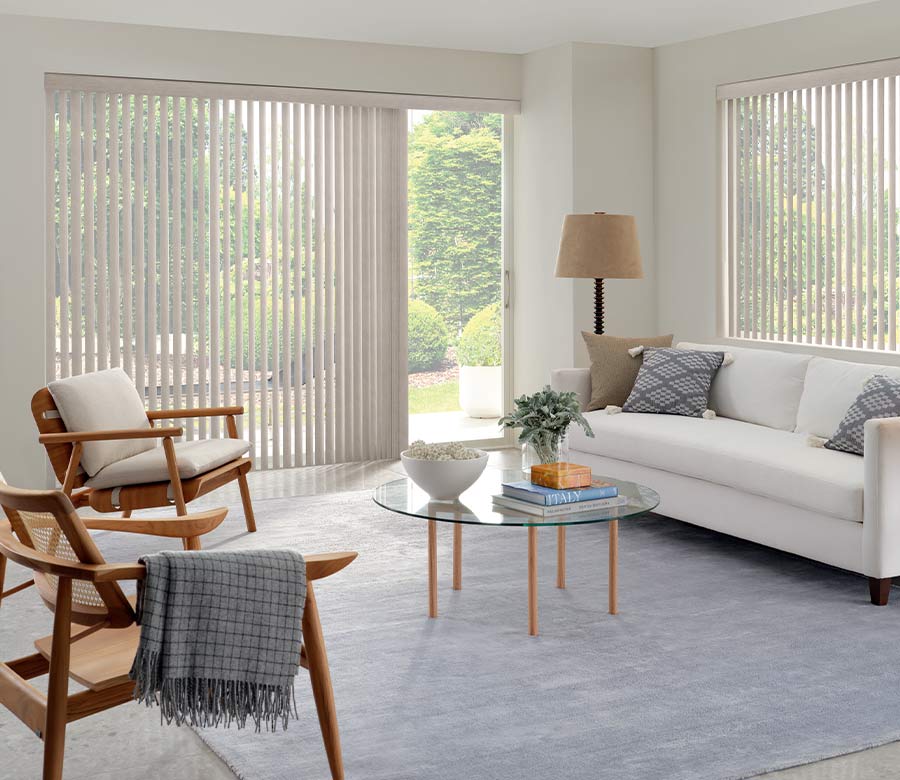
Panel track blinds operate on an entirely different principle than traditional verticals. Instead of dozens of narrow slats that clatter, tangle, and leave gaps, you get wide fabric panels—typically 18 to 24 inches across—that glide smoothly along a ceiling-mounted track. They overlap by 2 to 3 inches when closed, creating a continuous thermal barrier.
Insulation Performance That Actually Matters
The fabric panels used in modern panel track systems can achieve an R-value between 2.0 and 4.5 depending on material density and cellular construction (Source: Cellular Shades Thermal Performance Study, ASHRAE Journal, 2021). That’s four to nine times more insulating than your current vertical blinds. For a drafty sliding door in a White City ranch home, that difference translates directly into comfort you can feel and savings you can measure.
- Woven blackout panels: Best for bedrooms and media rooms; blocks 99% of light while adding R-3.2 insulation
- Light-filtering panels: Ideal for living rooms; softens harsh afternoon sun while still illuminating your space
- Solar screen panels: Reduces UV damage to flooring and furniture by up to 94% (Source: Skin Cancer Foundation, Window Film & Shade Guidelines, 2022)
- Room-darkening cellular panels: Honeycomb construction traps air for maximum thermal efficiency
Design Flexibility for Every Rouge Valley Home Style
The 1980s and 1990s tract homes throughout Rouge Valley share certain architectural DNA: open floor plans, neutral color palettes, and those oversized sliding glass doors that connect living spaces to backyards and patios. Panel track systems complement this layout beautifully. The clean horizontal lines add a contemporary edge without fighting your home’s existing character.
You can choose panels that coordinate with your wall color, contrast dramatically for a statement look, or incorporate patterns that add visual interest without overwhelming smaller rooms. Unlike vertical blinds—which come in approximately three colors (white, off-white, and that beige that’s seen better days)—panel tracks offer hundreds of fabric choices.
Comparing Your Options: Panel Tracks vs. Other Vertical Blind Replacements
Panel track systems aren’t the only way to replace outdated verticals, but they’re often the best choice for sliding doors specifically. Here’s how the alternatives stack up for typical Rouge Valley homes:
| Treatment Type | Insulation (R-Value) | Best For | Drawbacks |
|---|---|---|---|
| Panel Track Blinds | 2.0 – 4.5 | Sliding doors, large windows | Requires ceiling mount clearance |
| Vertical Cellular Shades | 3.0 – 4.0 | Sliding doors with minimal stacking space | Higher price point |
| Drapes/Curtains | 1.5 – 3.5 | Traditional aesthetics | Dust collection, requires frequent cleaning |
| Plantation Shutters | 2.5 – 3.0 | Hinged doors, fixed windows | Expensive; panels can block door operation |
| Traditional Vertical Blinds | 0.5 – 1.0 | Budget replacements only | Poor insulation, dated appearance, breaks easily |
For most Rouge Valley homeowners—especially those in Central Point neighborhoods where 1980s construction dominates—panel track blinds hit the sweet spot between performance, aesthetics, and value.
Why Medford and Ashland Homeowners Are Making the Same Switch
The trend extends beyond Rouge Valley proper. In Medford, sliding door panels have become the go-to upgrade for homeowners updating their tract homes before listing. Real estate agents report that modern window treatments can increase perceived home value by 3% to 5% (Source: National Association of Realtors, 2023 Home Staging Report). In Ashland, where arts-district aesthetics lean more eclectic, panel tracks in bold textures and colors let homeowners express personality while still solving the insulation problem.
Installation Considerations for Rouge Valley Sliding Doors
Proper installation makes or breaks the performance of any window treatment. Panel track systems require precise measurements and correct mounting to deliver their full insulating potential.
Measuring Your Sliding Glass Door Correctly
Your sliding door opening needs three measurements: width at the top, width at the bottom, and height on both sides. In older Rouge Valley homes, these numbers often differ by a quarter inch or more due to settling—which is why professional measurement matters. A panel track system that’s even half an inch too narrow will leave gaps that defeat the purpose of upgrading.
- Measure the full width of the glass area, not just the door frame
- Add 4 to 6 inches on each side for proper light blocking and draft prevention
- Measure height from where the track will mount (ceiling or wall) to your preferred stopping point
- Check for obstructions: ceiling fans, light fixtures, HVAC vents
- Verify that you have at least 4 inches of flat mounting surface above the door frame
Professional vs. DIY Installation
Panel track systems can be installed by handy homeowners, but the margin for error is smaller than with standard blinds. The track must be level—completely level—or the panels will drift to one side. In homes near the Jackson County Expo or anywhere in the White City area where foundation settling is common, achieving that level line often requires shimming and careful adjustment.
“I tried installing panel tracks myself after watching a YouTube video. Three hours later, I had a crooked track and panels bunching on the left side. The professional installer fixed everything in 45 minutes and showed me exactly why my measurements were off.”
— Susan R., Central Point (reduced her winter heating bill by 18% after proper installation)
Making the Right Choice for Your Rouge Valley Home
Your sliding glass door is one of the largest openings in your home’s thermal envelope. Every winter, that builder-grade treatment you’ve been tolerating lets cold air infiltrate your living space while heated air escapes. Pacific Power doesn’t offer refunds for wasted energy.
Panel track blinds solve the problem with style. They’re the modern vertical blind replacement that Rouge Valley homeowners deserve—especially those living in the tract homes that define neighborhoods from Central Point through White City. You get better insulation than traditional verticals, a cleaner look that updates your space, and a treatment that won’t break, tangle, or yellow within two years.
What to Expect During Your Free Measurement Appointment
When you schedule your free sliding door measurement, a window treatment specialist will visit your home and assess your specific situation. They’ll measure your door opening precisely, evaluate your mounting options, discuss fabric choices that match your décor, and provide a detailed quote with no hidden fees. The entire process takes about 30 minutes.
You’ll leave the appointment knowing exactly what your upgrade will cost, how long installation takes, and what kind of energy savings you can reasonably expect based on your specific door configuration. No pressure, no obligation—just the information you need to make a smart decision for your Rouge Valley home.
Ready to stop fighting those drafty vertical blinds? Schedule your free sliding door measurement today and discover why homeowners from Medford to Ashland are choosing panel track systems as their vertical blinds alternative. Your comfort—and your Pacific Power bill—will thank you.
Frequently Asked Questions About Panel Track Blinds in Rouge Valley
How long do panel track systems typically last?
Quality panel track blinds last 15 to 20 years with normal use, compared to 5 to 7 years for traditional vertical blinds (Source: Window Covering Manufacturers Association, Product Lifespan Study, 2020). The tracks use commercial-grade hardware, and panels can be replaced individually if damaged without replacing the entire system.
Can panel tracks work with my pet door insert?
Yes. Panel track systems accommodate pet door inserts by configuring the panels to stack away from the pet door location. Your installer can position the track so your pets access their door freely while the remaining panels still provide full coverage and insulation for the rest of the opening.
Do panel tracks require special cleaning?
Most panel track fabrics can be cleaned with a vacuum brush attachment or damp cloth. Unlike vertical blinds, which trap dust in their clips and headrails, panel tracks have minimal hardware exposure. Deep cleaning is rarely needed more than once per year, even in homes near dusty areas like Crater Rock Museum or the Jackson County Expo grounds.
Frequently Asked Questions
How much do panel track blinds cost compared to replacing vertical blinds?
Panel track systems typically cost $300 to $800 per sliding door opening, including professional installation. While that’s 2 to 3 times the cost of replacement vertical blinds, the energy savings, durability, and aesthetic improvement deliver better long-term value for Rouge Valley homeowners planning to stay in their homes.
Will panel tracks block all the light in my bedroom?
Room-darkening and blackout panel options block 95% to 99% of incoming light when properly installed with adequate side coverage. For complete darkness, pairing blackout panels with side channels eliminates edge light gaps—a popular choice for Central Point and White City homeowners with east-facing bedrooms.
Can I motorize panel track blinds for smart home integration?
Absolutely. Motorized panel track systems integrate with Alexa, Google Home, and Apple HomeKit platforms. You can program them to open at sunrise, close at sunset, or respond to temperature sensors—automating your energy savings without lifting a finger.

